Ten milestones of metalworking
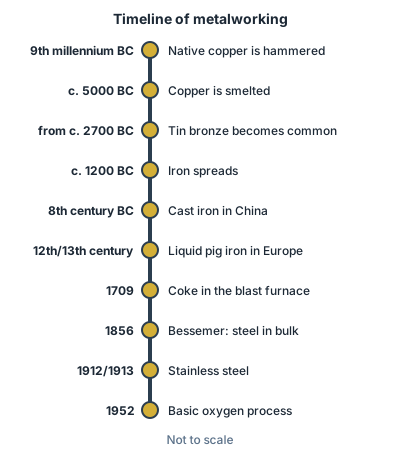
- 9th millennium BC – native copper is hammered and annealed in Anatolia
- c. 5000 BC – oldest direct evidence for smelting copper from ore (Belovode, Serbia)
- 3rd millennium BC – tin bronze prevails; in the Near East it becomes common from about 2700 BC
- c. 1200 BC – iron from the bloomery furnace spreads in the eastern Mediterranean
- 8th century BC – iron is produced in liquid form and cast in China
- 12th/13th century – shaft furnaces in Europe deliver liquid pig iron for the first time
- 1709 – Abraham Darby runs a blast furnace on coke instead of charcoal
- 1856 – the Bessemer process turns steel into a bulk product
- 1912/1913 – stainless steel is patented in Essen and, independently, melted in Sheffield
- 20th century – welding replaces riveting; the basic oxygen process, numerical control, lasers and additive manufacturing change production
1. Beginnings: native copper and the first smelting furnaces (to c. 3300 BC)
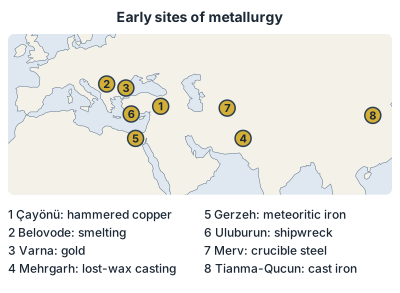
The history of metalworking does not begin with the furnace but with the hammer. Copper also occurs in nature as native metal. Copper minerals such as malachite were used as beads and pigment from the 11th millennium BC. At Çayönü Tepesi in south-eastern Anatolia, native copper was hammered towards the end of the 9th millennium BC and annealed in between so that it would not crack.1 This is metalworking without metallurgy: the metal is shaped, but not won from ore.
The decisive step is smelting, the extraction of metal from ore. The oldest direct evidence comes from Belovode in eastern Serbia: copper slag from a settlement of the Vinča culture, dated to about 5000 BC.12 A long-cited, even older find from Çatalhöyük in Anatolia has been regarded as refuted since 2017; the supposed slag is accidentally fired copper pigment.3 Crucible remains from Tal-i Iblis in Iran are only broadly dated between the late 6th and the late 5th millennium.1
Whether smelting was invented once and spread, or arose independently in several places, is an open question. Older research saw the Near East as the single origin. The finds from the Balkans suggest that there were several early centres.12
How far the craft had come in the 5th millennium is shown by the cemetery of Varna in Bulgaria (about 4550 to 4350 BC) with more than 3,000 gold objects weighing over 6 kg in total.4 From the same period comes the oldest known object cast by the lost-wax process, a copper amulet from Mehrgarh in present-day Pakistan (between 4500 and 3600 BC).5 The axe of the Iceman (“Ötzi”, 3350 to 3000 BC) is made of very pure copper whose ore came from southern Tuscany – metal was already being traded across the Alps.6
This phase is called the Copper Age or Chalcolithic. It begins and ends at very different times depending on the region; stone tools remained in use everywhere for a long time.
2. Bronze Age: alloys and long-distance trade (c. 3300–1200 BC)
Pure copper is soft. Alloying makes it harder. The first widespread alloy was not tin bronze but arsenical copper: in the 4th and early 3rd millennium BC most copper objects of the Near East contain arsenic. Tin bronze at first occurs only in isolated pieces and becomes common in Mesopotamia only from about 2700 BC.7 The year 3300 BC, often given as the beginning of the Bronze Age, marks the conventional start of the Early Bronze Age in the Near East, not the invention of tin bronze. In central Europe the Bronze Age begins only around 2200 BC.
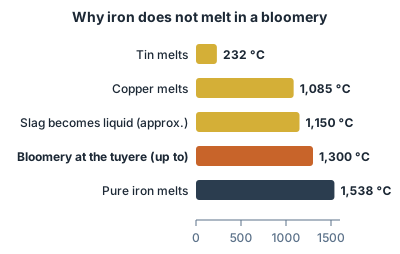
Tin bronze usually consists of copper with 5 to 12 per cent tin; about 10 per cent is classic.8 It is harder and stronger than copper and has a further advantage that is often misrepresented: it melts at a lower temperature than pure copper (1,085 °C) and is therefore easier to cast.9 The difficulty was not the temperature but supply. Tin is rare, and the deposits lie far from the centres of the Bronze Age. Analyses of tin ingots of the 13th and 12th centuries BC from the eastern Mediterranean point to Cornwall as the probable source; whether tin from Central Asia also played a part is disputed.10
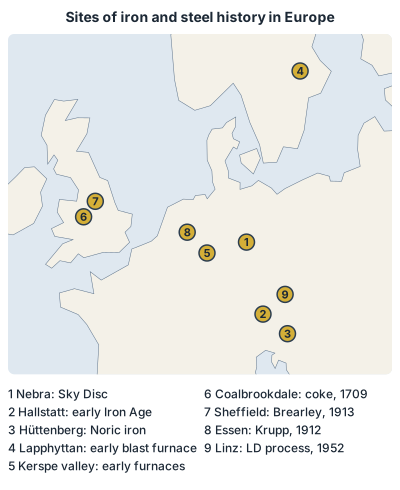
What this trade looked like is shown by the Uluburun shipwreck off the southern coast of Turkey (about 1320 BC): it carried copper and tin ingots in a ratio of about 10 to 1 – exactly the ratio needed for bronze.11 From central Europe comes the Nebra Sky Disc, deposited around 1600 BC; its copper comes from the eastern Alps, its gold from Cornwall.12
Technically, the Bronze Age brought casting in multi-part moulds of stone and clay, the lost-wax process for elaborate single pieces, and a specialised craft of founders and smiths.
3. Iron Age: a new metal from the bloomery (from c. 1200 BC)
The oldest known iron objects are nine beads from a grave at Gerzeh in Egypt, about 3200 BC. They are made of hammered meteoritic iron.13 The blade of the dagger from Tutankhamun’s tomb is also of meteoritic origin. Iron was at first a rare and precious material.
Winning iron from ore succeeded on a small scale as early as the early 2nd millennium BC in Anatolia. The widespread idea that the Hittites held a monopoly on iron and drew military superiority from it is regarded as refuted.14 The first large-scale spread took place in the late 2nd and early 1st millennium BC in the eastern Mediterranean and the Near East.14 In central Europe the Iron Age begins with the Hallstatt period around 800 BC.15
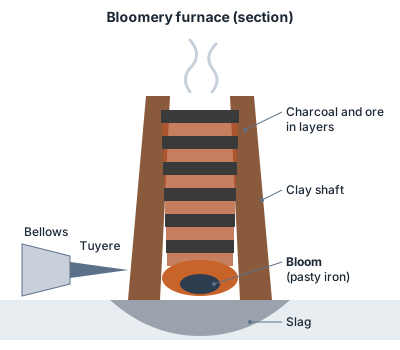
The iron was produced in the bloomery furnace, a clay shaft charged with charcoal and ore and supplied with air through tuyeres. Inside, temperatures range from about 500 °C in the upper part to as much as 1,300 °C in front of the tuyere. That is enough to reduce the ore to iron and to liquefy the slag, which melts at 1,100 to 1,200 °C and runs off. The melting point of iron, 1,538 °C, is not reached. The iron therefore forms as a solid: a spongy bloom shot through with slag. It is then repeatedly heated and forged until most of the slag has been squeezed out.16
Pure iron is hardly harder than bronze. It shows its advantage only as steel, when it takes up carbon. Carburising in a charcoal fire is attested on Cyprus for the 11th and 10th centuries BC; from the same period comes a knife that was quenched after heating.17 Early iron was by no means consistently hardened. That iron prevailed because it was superior to bronze from the start, or because tin became scarce, cannot be demonstrated.14 What is certain: iron ore occurs almost everywhere, whereas bronze depended on long-distance trade.
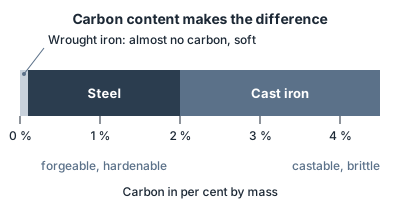
4. Antiquity and the Middle Ages: from bloomery to blast furnace (c. 500 BC to AD 1500)
Liquid iron was first produced in China. The oldest pieces of cast iron there date from the 8th century BC; in the 6th and 5th centuries BC agricultural implements were cast in iron, and from the 3rd century BC pig iron was fined into forgeable iron.18 In the Han period (206 BC to AD 220) the blast furnace was a mature process.19 Europe stayed with the bloomery for almost two millennia longer.
In the Roman Empire iron was produced and worked on a large scale. Noric iron from present-day Carinthia was well known. Iron served for tools and weapons, but also in building for clamps, anchors, fittings and grilles.
A special line runs through Central and South Asia: crucible steel. Iron is melted with carbon-bearing additions in closed crucibles. The oldest report dates from the 3rd century AD; furnaces have been excavated at Merv (8th to 9th century) and Akhsiket (9th to 12th century). From such steel came the patterned blades known as Damascus steel.20
In Europe water power changed ironmaking. From the High Middle Ages water wheels drove bellows and hammers. The furnaces grew taller and hotter: the bloomery became the Stückofen, which produced a large bloom, and from it developed the early blast furnace, in which the iron took up so much carbon that it became liquid.21 The earliest evidence dates from the 12th and 13th centuries. In the Sauerland region of Westphalia two furnaces at the Kerspe reservoir are dated to 1205–1300 and 1290–1395;22 similarly early plants are discussed for Sweden. Which region came first, and whether the technique was transmitted from Asia, has not been settled.
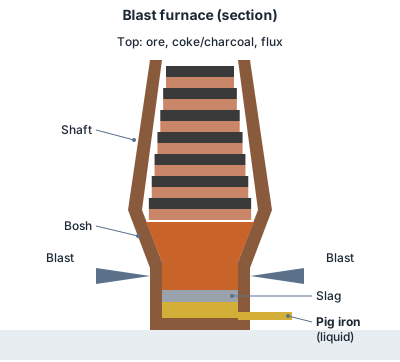
Liquid pig iron contains a great deal of carbon, is brittle and cannot be forged. In a second step it was therefore decarburised in the finery. This two-stage production – first pig iron, then fining – remained the basis of ironmaking into the 19th century. At the same time liquid iron made iron casting possible, which was in general use around 1500.21
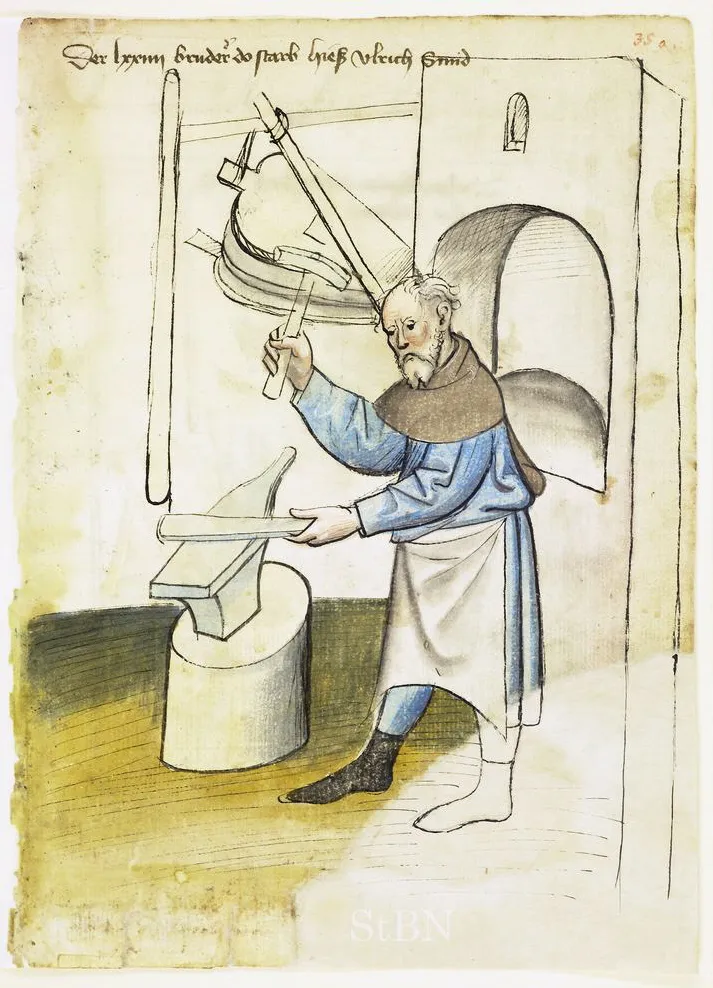 Smith at the anvil, forge and bellows in the background. House book of the Mendel Twelve Brothers’ Foundation, Nuremberg, about 1425 (Stadtbibliothek Nürnberg, Amb. 317.2°). Public domain.
In the Middle Ages the smith’s craft divided into specialised trades: farriers, cutlers, armourers, locksmiths. In Nuremberg wire drawing was mechanised with water power between 1408 and 1415.23 Locksmiths and art smiths made grilles, fittings, locks and railings – the forerunners of today’s metal fabrication.
5. Early modern period: mining and smelting are written down (c. 1500–1750)
For a long time the knowledge of miners and smelters was passed on only by word of mouth. In 1556 “De re metallica libri XII” by Georgius Agricola appeared in Basel, a year after his death. In twelve books and with 292 woodcuts it describes mining, ore dressing and smelting24 and long remained the standard textbook of the field.
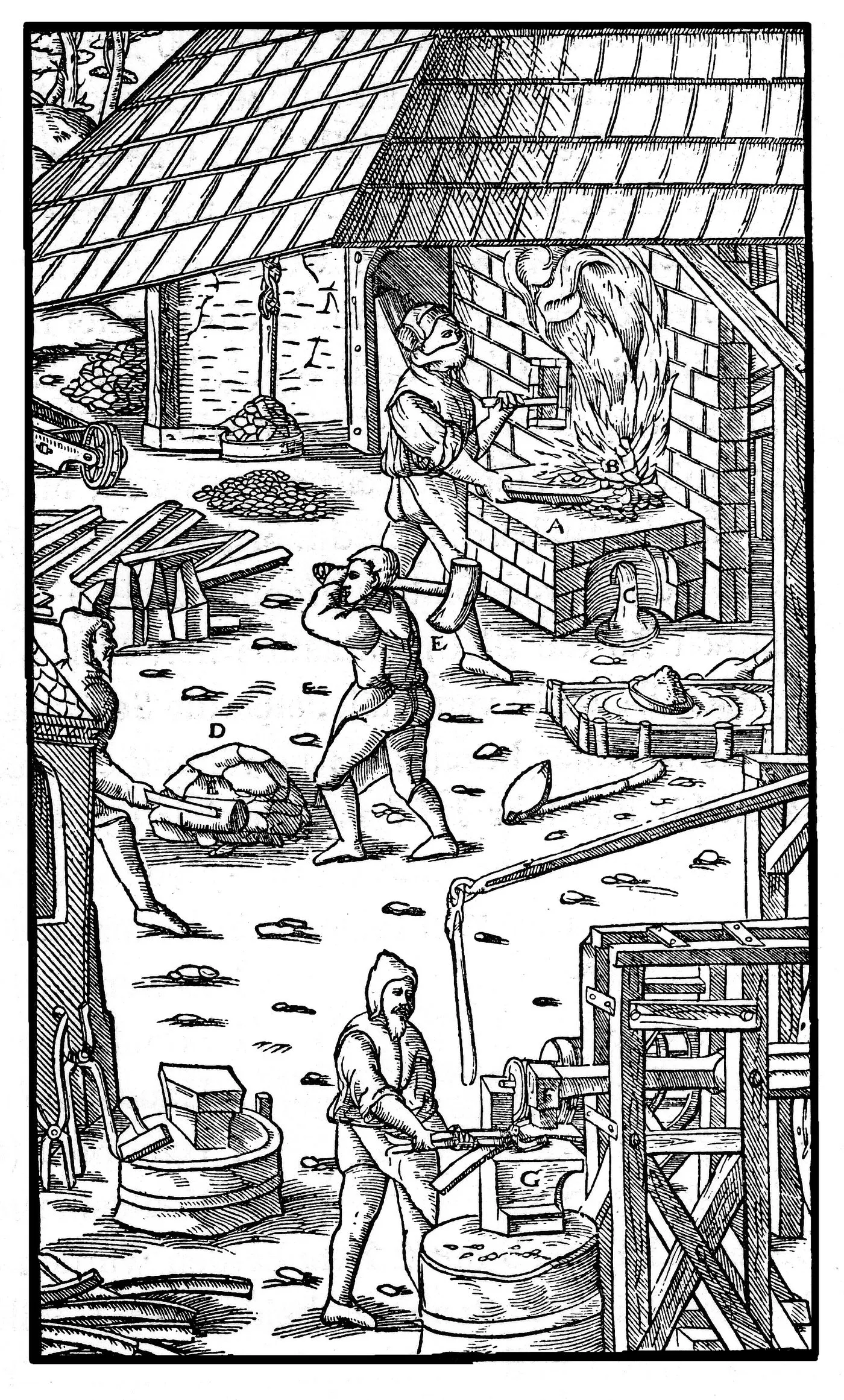 Bloomery works: the bloom is drawn from the furnace; in the foreground it is forged. Woodcut from Georgius Agricola, De re metallica, Basel 1556. Public domain.
Extensive iron districts arose in central Europe and Sweden. Water wheels drove bellows, hammers and wire-drawing benches; hammer mills supplied bar iron, sheet and wire as stock for smiths and locksmiths. The fuel remained charcoal, and the furnaces’ demand for wood limited production. In England Benjamin Huntsman began in the 1740s to melt and cast steel in crucibles (crucible cast steel).20
6. Industrial Revolution: coke, puddled iron and bulk steel (c. 1709–1900)
The way out of the wood shortage was found by Abraham Darby, who in 1709 ran a blast furnace on coke made from coal at Coalbrookdale in England. In Germany the first coke blast furnace went into operation at Gleiwitz in 1796.2125 The second bottleneck, fining, was solved by Henry Cort: in 1783 he patented rolling with grooved rolls, in 1784 puddling, in which pig iron is decarburised in a reverberatory furnace while being stirred.26 The result was wrought iron, also called puddled iron – tough and forgeable, but not produced in the liquid state.
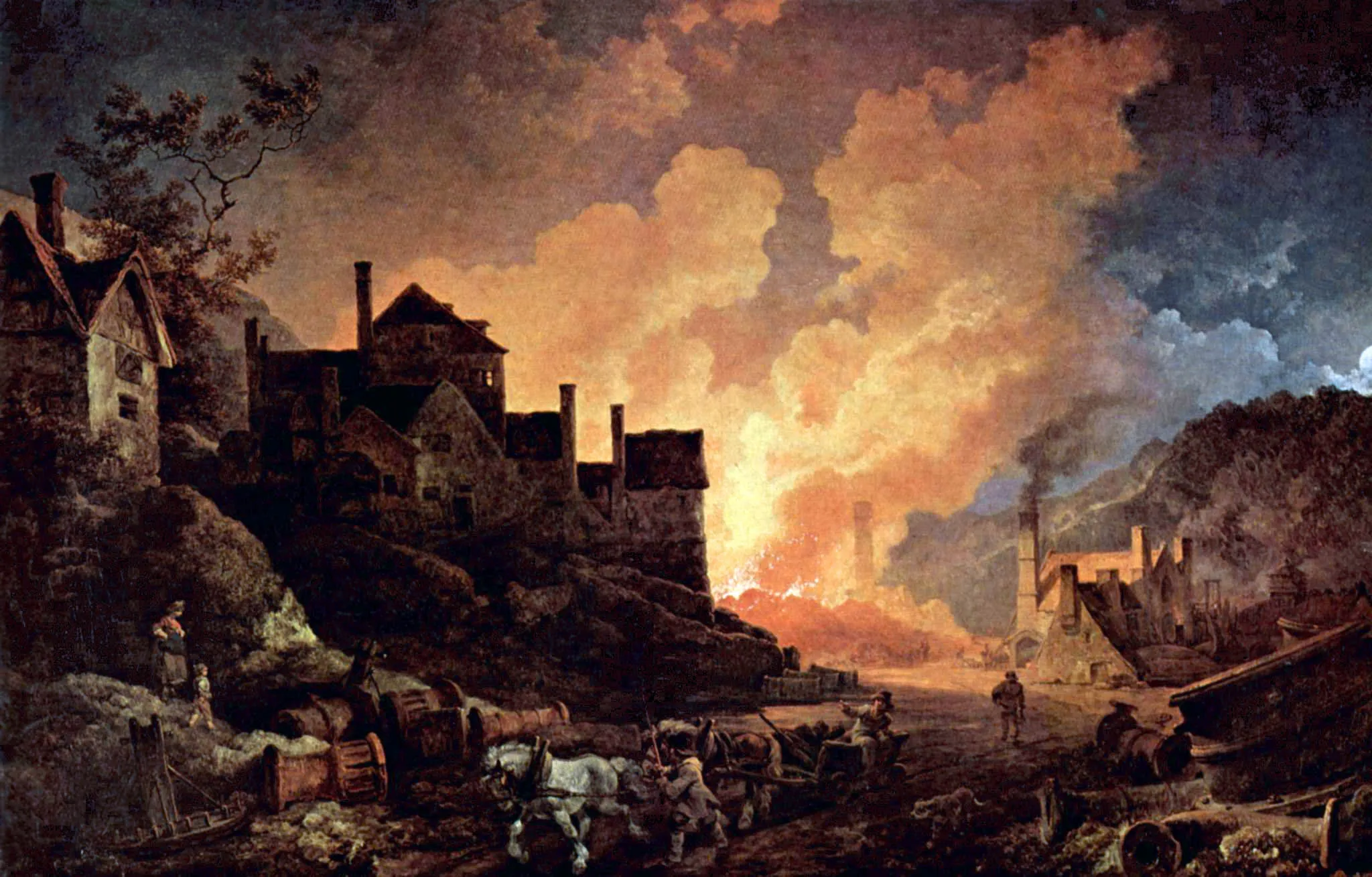 Coalbrookdale by Night. Painting by Philip James de Loutherbourg, 1801. Here Abraham Darby had first smelted iron with coke in 1709. Public domain.
Iron from Coalbrookdale was used in 1779 for the Iron Bridge across the Severn, the first major bridge made of cast iron; it opened in 1781.25
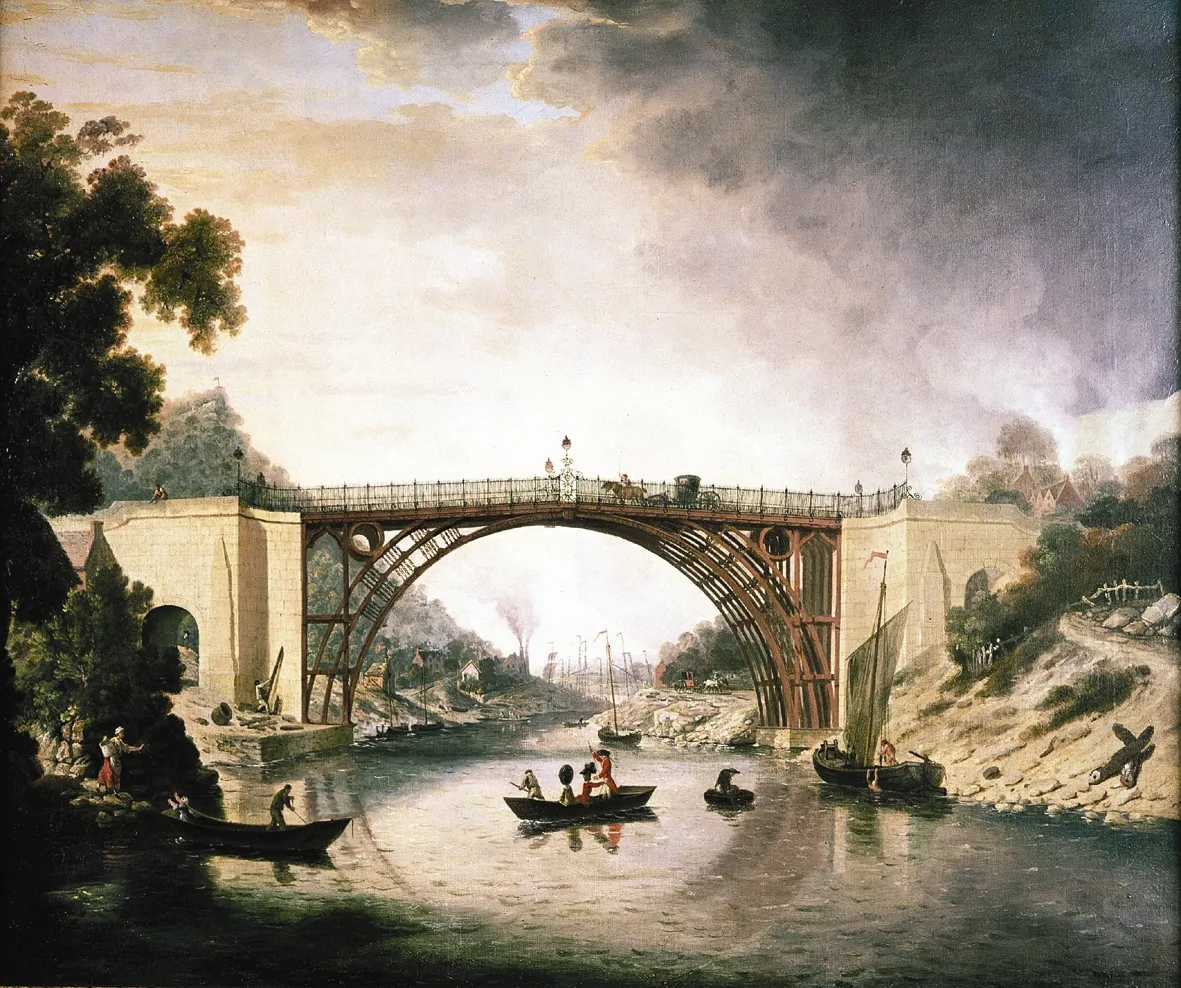 The Iron Bridge near Coalbrookdale. Painting by William Williams, 1780. Public domain.
Steel remained expensive until Henry Bessemer presented a process in 1856 that needs no additional fuel: air is blown through liquid pig iron in a tilting, pear-shaped vessel. The carbon burns and keeps the melt hot.2721 In a short time several tonnes of liquid steel are produced.
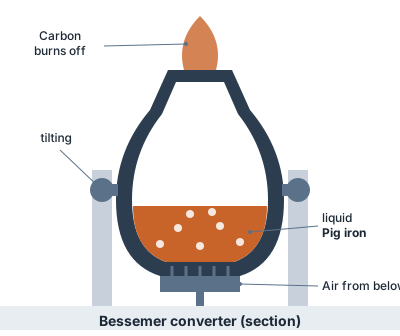
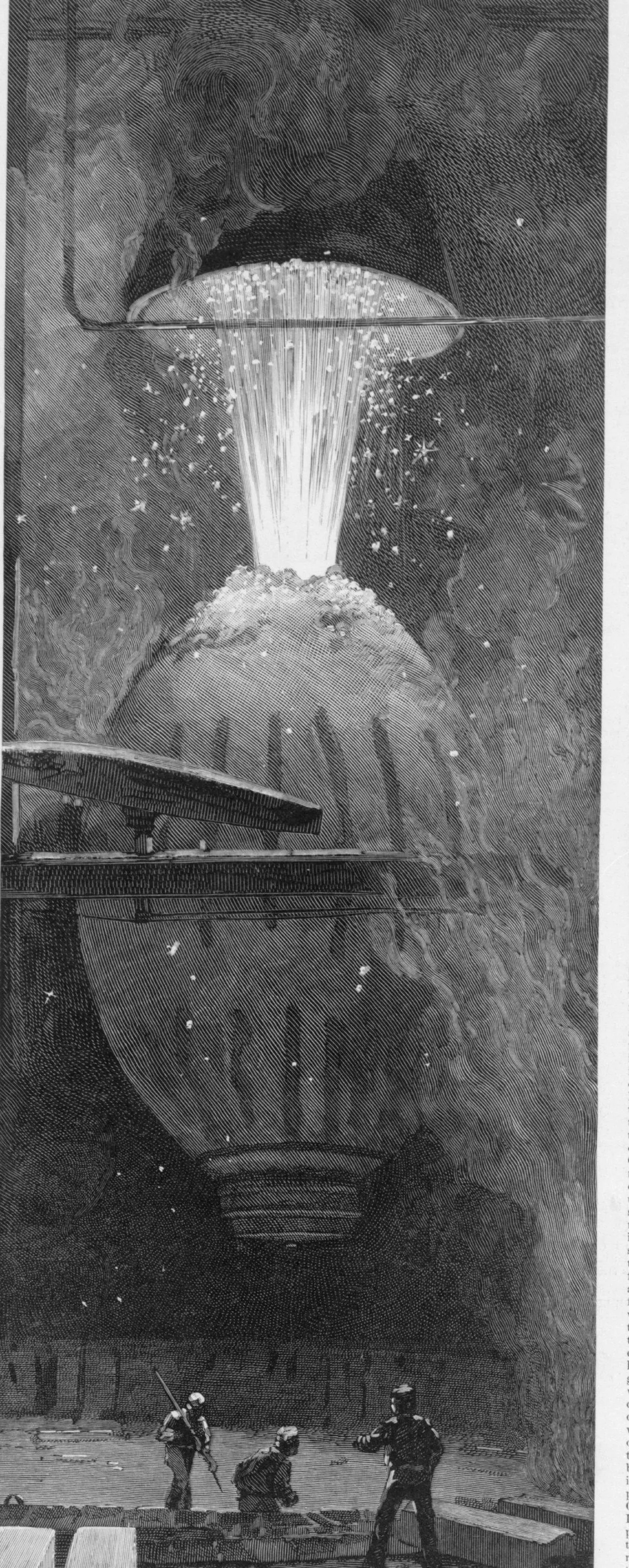 A Bessemer converter during the blow. Wood engraving from Harper’s Weekly, 23 February 1889 (Library of Congress). Public domain.
Two further processes complemented the converter. In 1864 Pierre-Émile Martin in France succeeded in melting steel in an open hearth using the regenerative firing of the Siemens brothers (Siemens-Martin or open-hearth process), which can also use scrap.2128 The Bessemer converter with its acid lining was suitable only for low-phosphorus pig iron. Sidney Gilchrist Thomas applied in 1877 for a patent on a process with a basic lining that binds the phosphorus; in 1879 came the breakthrough on a large scale.29 This made the phosphorus-rich ores of Lorraine and central Europe usable.
In construction the change came more slowly than is often described. Until about 1890 wrought iron was the usual structural material; even the Eiffel Tower of 1889 is made of puddled iron. The Eads Bridge in St. Louis of 1874 is regarded as the first major steel bridge.30 Around 1900 wrought iron and mild steel still stood side by side in the design tables, and in German the discipline was called “iron construction” until 1928.28
In 1886 Charles Martin Hall and Paul Héroult independently found the electrolysis of molten salts for producing aluminium; with the Bayer process for making alumina (1887) the precious metal became an everyday one.31
7. 20th century: stainless steel, welding, standardisation (c. 1900–2000)
Stainless steel has no single inventor. That chromium protects steel against corrosion had been described by metallurgists in France and Germany between 1904 and 1911. In 1912 the Krupp company in Essen applied for two patents on chromium-nickel steels based on work by Benno Strauß and Eduard Maurer; the designation V2A stems from this development.32 Independently, Harry Brearley melted a steel with 12.8 per cent chromium in Sheffield on 13 August 1913, from which stainless knives were made.33
Welding fundamentally changed fabrication. The carbon arc was patented in 1885, welding with a metal electrode developed in 1888, the coated electrode in 1907/1908 by Oscar Kjellberg. Gas welding with acetylene and oxygen appeared shortly after 1900. Later came submerged arc welding (1930), TIG welding (1941), gas metal arc welding (1948) and welding under carbon dioxide (1953).3435 In structural steelwork the riveted joint lost ground from the 1920s; in 1931 a German standard for welded steel structures, DIN 4100, was published. After 1945 the weld and the high-strength bolt displaced the rivet almost completely.28
Standardisation made it possible for parts from different makers to fit together. On 22 December 1917 the Standards Committee of German Industry was founded, today’s DIN. The first standard, DIN 1 for taper pins, appeared in 1918.36
In steelmaking the basic oxygen process (LD process), which started up in Linz in 1952, replaced the older converters and later the open-hearth furnace.3721 In fabrication, the numerically controlled milling machine (1952) began the automation of machine tools. In 1967 the first laser cut with oxygen as assist gas succeeded; around 1970 the first machines were at work in production.38
8. Today: design on the computer, fabrication to standard (from c. 2000)
Today’s processes continue what began in the 20th century. Components are designed on the computer; lasers, plasma and water jets cut from these data. For laser powder bed fusion of metal, the basis of metal 3D printing, the fundamental patent was filed in 1996.39 Welding processes, materials and the qualification of personnel are standardised across Europe.
What has remained is the division of labour that developed from the Middle Ages onwards: ironworks produce the material, rolling mills the stock, and locksmiths and metal fabricators join it into components – today welded instead of riveted, from drawings instead of by eye.
Iron in Westphalia and the Siegerland
The general development can be followed particularly closely in one region: the hill country east of the Rhine between the rivers Sieg, Lenne and Ruhr. Here ore, woodland and water power lie close together.
Iron Age. Iron has been smelted in the Siegerland since the Iron Age, probably from the 6th century BC and on a large scale from the 4th and above all the 3rd century BC.40 A research project of the German Mining Museum Bochum, the LWL archaeology service for Westphalia and the Ruhr University Bochum studied this iron economy from 2002 to 2020.40 At Gerhardsseifen near Siegen-Niederschelden two dome-shaped smelting furnaces with slag heap, smithing site and roasting pit were excavated.41 The Siegerland furnaces are regarded as the largest known smelting furnaces of their time in Europe; one domed furnace measured 1.20 m in internal diameter and was almost 2 m high.4240
Middle Ages. In the Sauerland more than a hundred sites of early blast furnaces are known – the highest density of such works in late medieval Europe.22 The two furnaces at the Kerspe reservoir, of the 13th and 14th centuries, had an outer diameter of 3 m but an inner width of only 0.80 m.22 In the Siegerland the fuel came from the Hauberg system, a cooperative form of coppice forestry that is today listed in Germany’s national inventory of intangible cultural heritage.43
Early modern period. In the Sauerland the pig iron of the early blast furnaces was fined into Osemund, a soft, easily forged iron. It went from Lüdenscheid to Altena and was drawn into wire there; in Iserlohn it was made into needles, eyelets and chains.44 Two ironworks of this period survive: the Wendener Hütte of 1728, whose blast furnace ran until 1866, and the Luisenhütte at Balve-Wocklum, started up in 1758 and used for making pig iron until 1865. It is regarded as the oldest completely preserved charcoal blast furnace plant in Germany.4546
Iron was also produced on the edge of the Paderborn region. In the Egge hills near Altenbeken ironmaking is documented from 1392; the last works closed in 1926. Its main products were stoves and stove plates.47
Industrialisation. In 1758 pig iron flowed for the first time from a blast furnace in what was to become the Ruhr district, at the St. Antony ironworks in Oberhausen.48 On 20 November 1811 Friedrich Krupp founded his cast steel works in Essen.49 In Bochum Jacob Mayer developed steel casting in moulds and applied for a patent in 1851; his cast steel bells became famous.50 The first coke blast furnace of the district was built in 1848/49 at the Friedrich Wilhelms-Hütte in Mülheim an der Ruhr.51 On 22 September 1879 the first Thomas heat in Germany was blown at Hörde, at the same time as at Duisburg-Meiderich.52
The end. Iron ore mining on the Sieg and Wied ended on 31 March 1965 with the closure of the last mines.53 In Hattingen the last blast furnace of the Henrichshütte ceased operation in 1987; a coke blast furnace of 1939 survives there as the oldest in the Ruhr district.54
From smith to metal fabricator: the craft
Alongside the history of processes stands the history of those who work the metal. It is a history of the division of labour.
Guilds. In the towns of the Middle Ages craftsmen joined together in guilds. In Augsburg craft organisations can be traced as early as the town law of 1156; most guilds of Upper Germany appear in the 14th century.55 Specialised trades gradually separated from the smith’s craft: farriers, cutlers, nailsmiths and the locksmiths, who made locks, fittings and grilles. Nuremberg was an exception: guilds were forbidden there after the craftsmen’s uprising of 1348/49 and the council supervised the crafts itself; in the first half of the 17th century 114 crafts were counted there.23
What the work looked like is shown by the house books of the Nuremberg Twelve Brothers’ Foundations. From 1425 every deceased brother was painted practising his former craft. Of 799 pictures, 773 survive, and the metalworking trades are the most strongly represented.56
Wrought ironwork in architecture. In the 17th and 18th centuries wrought iron became a building task of the first rank. Jean Tijou was commissioned in 1689 to make the screens in the garden of Hampton Court.57 Jean Lamour created the gilded gates of the Place Stanislas in Nancy, laid out between 1752 and 1756.58 In Würzburg the court locksmith Johann Georg Oegg began the screen of the Residence’s court of honour in 1735 and made the Greiffenclau Gate at the court garden in 1750/51.59
Freedom of trade and the Crafts Code. With the Prussian trade tax edict of 2 November 1810 the privileges of the guilds lapsed.60 The trade regulations of the North German Confederation of 1869 applied throughout the German Empire from 1871. In 1897 an amendment created the basis for the chambers of crafts; in 1908 the minor and in 1935 the major certificate of competence followed.61 The Crafts Code of the Federal Republic dates from 17 September 1953.62
The metal fabricator. In 1989 the metal crafts in Germany were reorganised. The old training occupations of locksmith and smith were abolished and replaced by the Metallbauer (metal fabricator), at first with five specialisations, since 2002 with three, among them structural engineering and metal design.62
Other metals
Copper and iron dominate this history, but not alone.
Silver and lead. From the 4th millennium BC silver was won from silver-bearing lead ores. The lead is oxidised to litharge in the heat, and the silver remains (cupellation). The oldest evidence comes from Tepe Sialk in Iran, from eastern Anatolia and from northern Syria. Until the 18th century most silver came from this process.63 How large lead smelting was in antiquity can be read in the ice of Greenland: lead deposition between 1100 BC and AD 800 reaches its maximum under the Roman Empire.64
Zinc and brass. Zinc vaporises before it can be smelted from the ore and was therefore long unknown as a metal. Brass could nevertheless be made by heating copper with zinc ore (cementation). From the monetary reform of Augustus in 23 BC the Romans struck coins of brass with 5 to 28 per cent zinc.65 Metallic zinc was produced by distillation at Zawar in India, on a large scale between about 1100 and 1500. In Europe William Champion patented a process in 1738 and produced zinc on an industrial scale near Bristol from the 1740s; in 1746 Andreas Sigismund Marggraf isolated the metal in the laboratory.66
Aluminium, nickel, magnesium, titanium. The light metals are children of 18th- and 19th-century chemistry. Nickel was described by Axel Fredrik Cronstedt in 1751, magnesium isolated by Humphry Davy in 1808, aluminium prepared by Hans Christian Ørsted in 1825 and in improved form by Friedrich Wöhler in 1827. Titanium was discovered by William Gregor in Cornwall in 1791 and named by Martin Heinrich Klaproth in 1795; pure metal was not obtained until 1910.67 Titanium became technically usable through Wilhelm Kroll’s process, patented in the USA in 1940; production grew rapidly in the 1950s, at first for military aviation.68
Glossary
| Term | Meaning |
|---|---|
| Smelting | winning metal from ore by heat and a reducing agent, usually carbon |
| Native | occurring in nature as metal, not bound in an ore |
| Bloomery | shaft furnace in which the iron stays solid and only the slag runs off |
| Bloom | the spongy lump of iron from the bloomery, shot through with slag |
| Stückofen | larger medieval bloomery producing one big bloom |
| Pig iron | carbon-rich, brittle iron from the blast furnace; cannot be forged |
| Fining | decarburising pig iron into forgeable iron or steel |
| Osemund | soft iron from the finery hearths of the Sauerland, stock for wire |
| Puddling | fining in a reverberatory furnace with stirring (Henry Cort, 1784) |
| Wrought iron | iron produced in the pasty state in bloomery, finery or puddling furnace |
| Mild steel | steel produced in the liquid state in converter or open hearth |
| Carburising | enriching the surface layer of iron with carbon |
| Cupellation | separating silver and lead by oxidising the lead |
| Cementation | heating a metal with an addition that diffuses into it – zinc for brass, carbon for steel |
| Alloy | metal of two or more constituents, such as bronze of copper and tin |
Chronological overview
| Phase | Period | Characteristics |
|---|---|---|
| Before smelting | 11th–6th millennium BC | copper minerals as ornament, native copper hammered and annealed |
| Copper Age | c. 5000–3300 BC, varying by region | smelting of copper, gold, lost-wax casting |
| Bronze Age | c. 3300–1200 BC (Near East) | arsenical copper, then tin bronze; long-distance trade in tin |
| Iron Age | from c. 1200 BC, central Europe from c. 800 BC | bloomery, bloom, carburising and hardening |
| Antiquity / Middle Ages | c. 500 BC–AD 1500 | cast iron in China; in Europe water power, Stückofen, early blast furnace |
| Early modern period | c. 1500–1750 | Agricola 1556, hammer mills, crucible cast steel |
| Industrial Revolution | c. 1709–1900 | coke, puddling, Bessemer, open hearth, Thomas |
| 20th century | c. 1900–2000 | stainless steel, welding, standardisation, basic oxygen process |
| Today | from c. 2000 | computer-aided design, lasers, additive manufacturing |
Where research disagrees
- One origin or several: whether copper smelting was invented in the Near East or arose independently in several places is open. Belovode is the oldest direct evidence, not necessarily the oldest place.
- Oldest tin bronze: a find from Pločnik in Serbia (about 4650 BC) is discussed as the oldest tin bronze. Whether it is a deliberate alloy is disputed.
- Source of the tin: for the Late Bronze Age both Cornwall and Central Asia are named; the analyses come to different results.
- Oldest blast furnace in Europe: the early plants in Sweden and the Sauerland are so close in date that no order can be established.
- Dates of inventions: for processes of the 19th and 20th centuries the years differ by one or two depending on the source, because patent application, publication and first operation fall apart.
Sources and literature
Early metallurgy
- Radivojević, M.; Rehren, Th.; Pernicka, E.; Šljivar, D.; Brauns, M.; Borić, D.: On the origins of extractive metallurgy: new evidence from Europe. Journal of Archaeological Science 37 (2010).
- Radivojević, M.; Roberts, B. W.: Early Balkan Metallurgy: Origins, Evolution and Society, 6200–3700 BC. Journal of World Prehistory 34 (2021), 195–278. doi:10.1007/s10963-021-09155-7
- Radivojević, M.; Rehren, Th.; Farid, S.; Pernicka, E.; Camurcuoğlu, D.: Repealing the Çatalhöyük extractive metallurgy: The green, the fire and the “slag”. Journal of Archaeological Science 86 (2017), 101–122. doi:10.1016/j.jas.2017.07.001
- Thoury, M. et al.: High spatial dynamics-photoluminescence imaging reveals the metallurgy of the earliest lost-wax cast object. Nature Communications 7 (2016), 13356. doi:10.1038/ncomms13356
- Artioli, G. et al.: Long-distance connections in the Copper Age: New evidence from the Alpine Iceman’s copper axe. PLOS ONE 12(7) (2017), e0179263. doi:10.1371/journal.pone.0179263
- Higham, T.; Slavchev, V.; Gaydarska, B.; Chapman, J.: AMS Dating of the Late Copper Age Varna Cemetery, Bulgaria. Oxford University Research Archive
Bronze and tin
- Cleuziou, S.; Berthoud, Th.: Early Tin in the Near East. Expedition 25(1) (1982), Penn Museum. penn.museum
- Maddin, R.; Wheeler, T. S.; Muhly, J. D.: Tin in the Ancient Near East. Expedition 19(2) (1977), Penn Museum. penn.museum
- Royal Society of Chemistry: Periodic Table – Copper, Tin, Iron (melting points). periodic-table.rsc.org
- Berger, D. et al.: Isotope systematics and chemical composition of tin ingots from Mochlos (Crete) and other Late Bronze Age sites in the eastern Mediterranean Sea. PLOS ONE 14(6) (2019), e0218326. doi:10.1371/journal.pone.0218326
- Institute of Nautical Archaeology: Uluburun Late Bronze Age Shipwreck Excavation. nauticalarch.org
- Landesamt für Denkmalpflege und Archäologie Sachsen-Anhalt: Zur Datierung der Himmelsscheibe von Nebra (2020, on the dating of the Nebra Sky Disc). lda-lsa.de
Iron and steel to the Middle Ages
- Rehren, Th. et al.: 5,000 years old Egyptian iron beads made from hammered meteoritic iron. Journal of Archaeological Science 40 (2013), 4785–4792.
- Erb-Satullo, N. L.: The Innovation and Adoption of Iron in the Ancient Near East. Journal of Archaeological Research 27 (2019), 557–607. doi:10.1007/s10814-019-09129-6
- Naturhistorisches Museum Wien, Prähistorische Abteilung: Ältere Eisenzeit. nhm.at
- Güder, Ü.; Mokrišová, J.; Verčík, M.; Yalçın, Ü.: Earliest evidence for systematic use of ultrahigh carbon steel in the ancient Aegean. PLOS ONE 20(3) (2025), e0312244. doi:10.1371/journal.pone.0312244
- Historical Metallurgy Society: Archaeology Datasheet 301 – Iron: bloomery smelting and associated processes. historicalmetallurgy.org
- Liu, Y.; Wood, J. R.: Questioning Diversity (of Iron) in the Workplace: Bloomery Iron, Cast Iron, China and the West. Internet Archaeology 69 (2025). doi:10.11141/ia.69.14
- Jesus College, University of Cambridge: Iron and steel in Chinese history. jesus.cam.ac.uk
- Craddock, P. T.; Lang, J.: Crucible Steel – Bright Steel. Historical Metallurgy 38(1) (2004), 35–46.
- Universität Münster, Abteilung für Ur- und Frühgeschichtliche Archäologie: Mittelalterliche Eisenverhüttung im Märkischen Sauerland. uni-muenster.de
- Diefenbacher, M.: Nürnberg, Reichsstadt: Handwerk. Historisches Lexikon Bayerns. historisches-lexikon-bayerns.de
Modern period and industry
- Agricola, G.: De re metallica libri XII. Froben, Basel 1556. Description of the copy: Bibliothek des Deutschen Museums.
- Stahlinstitut VDEh: Geschichte der Eisenhüttentechnik (topic paper). vdeh.de
- Science Museum Group: Henry Bessemer. sciencemuseumgroup.org.uk
- English Heritage: History of Iron Bridge. english-heritage.org.uk
- Dictionary of National Biography (1885–1900): Cort, Henry; Thomas, Sidney Gilchrist. Wikisource
- Entwicklung der Eisen- und Stahlbauweise (chapter 1, sample). Ernst & Sohn, Berlin, ISBN 978-3-433-01849-1. wiley-vch.de
- National Park Service: Eads Bridge. nps.gov
- The Electrochemical Society: Interface, Summer 2014, pp. 36–37 (Hall, Héroult and the Bayer process). electrochem.org
- British Stainless Steel Association: The Discovery of Stainless Steel. bssa.org.uk
- Deutsche Biographie: Strauß, Benno. deutsche-biographie.de
- Cobb, H. M.: The History of Stainless Steel. ASM International, Materials Park 2010.
- The Welding Institute (TWI): The history of welding. twi-global.com
- Kjellberg Finsterwalde: Unternehmensgeschichte. kjellberg.de
- Fraunhofer-Institut für Lasertechnik ILT: 25 Jahre Patent zum Laserstrahlschmelzen (2021). ilt.fraunhofer.de
- Hilton, P. A.: The early days of laser cutting. 11th Nordic Conference in Laser Processing of Materials, Lappeenranta 2007. twi-global.com
- voestalpine: 60 Jahre LD-Verfahren (2012). voestalpine.com
- DIN e. V.: Chronik (as of 2020). din.de
Westphalia and the Siegerland
- Deutsches Bergbau-Museum Bochum: Latènezeitliche Eisenwirtschaft im Siegerland (project page). bergbaumuseum.de
- Landschaftsverband Westfalen-Lippe: press release of 2 April 2019 on the excavations at Gerhardsseifen. lwl.org
- Informationsdienst Wissenschaft: Eisenverhüttung im Siegerland (conference notice). idw-online.de
- LWL: Industriekultur in Stadt und Land (Ostwestfalen-Lippe), Eisenhütte Altenbeken. lwl.org
- Deutsche Stiftung Denkmalschutz: Luisenhütte Wocklum. denkmalschutz.de
- Gemeinde Wenden: Wendener Hütte. wenden.de
- Stadt Lüdenscheid: Drahthandelsweg. luedenscheid.de
- LVR-Industriemuseum: St. Antony-Hütte. lvr.de
- thyssenkrupp Steel: Chronik. thyssenkrupp-steel.com
- Neue Deutsche Biographie: Mayer, Jacob. deutsche-biographie.de
- Rheinische Industriekultur: Friedrich Wilhelms-Hütte, Mülheim an der Ruhr. rheinische-industriekultur.com
- Museum des Heimatvereins Hörde: Thomasbirne (object description). museum-digital.de
- Schäfer, A.: Das Ende des Siegerländer-Wieder Erzbergbaus vor 50 Jahren (2015). qr-kultur.de
- LWL: Henrichshütte Hattingen. lwl.org
- Kultusministerkonferenz: Bundesweites Verzeichnis Immaterielles Kulturerbe (as of March 2020). kmk.org
The craft
- Sczesny, A.: Zünfte. Historisches Lexikon Bayerns. historisches-lexikon-bayerns.de
- Sauer, Chr.: Hausbücher der Nürnberger Zwölfbrüderstiftungen. Historisches Lexikon Bayerns. historisches-lexikon-bayerns.de
- Elkar, R. S.: Handwerkskammern (bis 1945). Historisches Lexikon Bayerns. historisches-lexikon-bayerns.de
- Radtke, W.: Die Einführung der allgemeinen Gewerbefreiheit 1810. Historische Kommission zu Berlin. hiko-berlin.de
- Bundesagentur für Arbeit: Berufsinformation Metallbauer/in (archive). arbeitsagentur.de
- The Art Newspaper: Hampton Court Palace’s Tijou screens (16 December 2021). theartnewspaper.com
- UNESCO: Place Stanislas, Place de la Carrière and Place d’Alliance in Nancy. whc.unesco.org
- Friedrich, V.: Oegg, Johann Georg. Neue Deutsche Biographie (1999). deutsche-biographie.de
Other metals
- Pernicka, E.: Silver production by cupellation in the fourth millennium BC at Tepe Sialk. In: Shahmirzadi, S. M. (ed.): The Potters of Sialk. Teheran 2004, 69–71. d-nb.info
- McConnell, J. R. et al.: Lead pollution recorded in Greenland ice indicates European emissions tracked plagues, wars, and imperial expansion during antiquity. PNAS 115(22) (2018), 5726–5731. doi:10.1073/pnas.1721818115
- Di Fazio, M. et al.: Microstructure and chemical composition of Roman orichalcum coins emitted after the monetary reform of Augustus (23 B.C.). Scientific Reports 9 (2019). PMC6722059
- Dungworth, D.; White, H.: Scientific examination of zinc-distillation remains from Warmley, Bristol. Historical Metallurgy 41(1), 77–83. hmsjournal.org
- Royal Society of Chemistry: Periodic Table – Zinc, Aluminium, Titanium, Nickel, Magnesium. periodic-table.rsc.org
- Gambogi, J.; Gerdemann, S. J.: Titanium Metal: Extraction to Application. U.S. Department of Energy, DOE/ARC-1999-060. osti.gov
- Kroll, W.: Method for Manufacturing Titanium and Alloys Thereof. US-Patent 2,205,854, granted 25 June 1940. patents.google.com
General survey
- Tylecote, R. F.: A History of Metallurgy. 2nd edition, Institute of Materials, London 1992.
The diagrams are the author’s own schematic drawings. The historical illustrations are in the public domain and come from Wikimedia Commons.
This is a translation of the German article Geschichte der Metallverarbeitung. As of October 2026. Notes on errors or more recent research are welcome.
Notes
The short references point to the full titles under “Sources and literature”.
Footnotes
-
Radivojević et al. 2017. ↩
-
Higham et al., AMS Dating of the Late Copper Age Varna Cemetery. ↩
-
Thoury et al. 2016. ↩
-
Artioli et al. 2017. ↩
-
Cleuziou and Berthoud 1982. ↩
-
Maddin, Wheeler and Muhly 1977. ↩
-
Royal Society of Chemistry, Periodic Table: copper 1,084.62 °C, tin 231.93 °C, iron 1,538 °C. ↩
-
Berger et al. 2019. ↩
-
Institute of Nautical Archaeology, Uluburun. ↩
-
Landesamt für Denkmalpflege and Archäologie Sachsen-Anhalt 2020. ↩
-
Rehren et al. 2013. ↩
-
Naturhistorisches Museum Wien, Ältere Eisenzeit. ↩
-
Historical Metallurgy Society, Archaeology Datasheet 301. ↩
-
Güder et al. 2025. ↩
-
Liu and Wood 2025. ↩
-
Jesus College Cambridge, Iron and steel in Chinese history. ↩
-
Stahlinstitut VDEh, Geschichte der Eisenhüttentechnik. ↩ ↩2 ↩3 ↩4 ↩5 ↩6
-
Universität Münster, Mittelalterliche Eisenverhüttung im Märkischen Sauerland. ↩ ↩2 ↩3
-
Bibliothek des Deutschen Museums, De re metallica. ↩
-
Dictionary of National Biography, article “Cort, Henry”. ↩
-
Science Museum Group, Henry Bessemer. ↩
-
Entwicklung der Eisen- und Stahlbauweise, chapter 1 (Ernst & Sohn). ↩ ↩2 ↩3
-
Dictionary of National Biography, article “Thomas, Sidney Gilchrist”. ↩
-
National Park Service, Eads Bridge. ↩
-
The Electrochemical Society, Interface, Summer 2014. ↩
-
Deutsche Biographie, article “Strauß, Benno”. ↩
-
British Stainless Steel Association, The Discovery of Stainless Steel. ↩
-
The Welding Institute, The history of welding. ↩
-
Kjellberg Finsterwalde, Unternehmensgeschichte. ↩
-
DIN e. V., Chronik. ↩
-
voestalpine 2012. ↩
-
Hilton 2007. ↩
-
Fraunhofer ILT 2021. ↩
-
Deutsches Bergbau-Museum Bochum, Latènezeitliche Eisenwirtschaft im Siegerland. ↩ ↩2 ↩3
-
Informationsdienst Wissenschaft, Eisenverhüttung im Siegerland. ↩
-
Landschaftsverband Westfalen-Lippe, press release of 2 April 2019. ↩
-
Kultusministerkonferenz, Bundesweites Verzeichnis Immaterielles Kulturerbe. ↩
-
Stadt Lüdenscheid, Drahthandelsweg. ↩
-
Gemeinde Wenden, Wendener Hütte. ↩
-
Deutsche Stiftung Denkmalschutz, Luisenhütte Wocklum. The foundation speaks of the oldest completely preserved blast furnace plant in Europe, the NRW-Stiftung of the oldest known charcoal blast furnace plant in Germany. ↩
-
LWL, Industriekultur in Stadt and Land, Eisenhütte Altenbeken. ↩
-
LVR-Industriemuseum, St. Antony-Hütte. ↩
-
thyssenkrupp Steel, Chronik. ↩
-
Neue Deutsche Biographie, article “Mayer, Jacob”. ↩
-
Rheinische Industriekultur, Friedrich Wilhelms-Hütte. ↩
-
Museum des Heimatvereins Hörde, object description of the Thomas converter. ↩
-
Schäfer 2015. ↩
-
LWL, Henrichshütte Hattingen. ↩
-
Sczesny, Historisches Lexikon Bayerns. ↩
-
Sauer, Historisches Lexikon Bayerns. ↩
-
The Art Newspaper, 16 December 2021. ↩
-
UNESCO World Heritage List, no. 229. ↩
-
Friedrich, Neue Deutsche Biographie. ↩
-
Radtke, Historische Kommission zu Berlin. ↩
-
Elkar, Historisches Lexikon Bayerns. ↩
-
Bundesagentur für Arbeit, Berufsinformation Metallbauer/in. ↩ ↩2
-
Pernicka 2004. ↩
-
McConnell et al. 2018. ↩
-
Di Fazio et al. 2019. ↩
-
Royal Society of Chemistry, Periodic Table (Zinc); Dungworth and White. ↩
-
Royal Society of Chemistry, Periodic Table (Nickel, Magnesium, Aluminium, Titanium). ↩
-
Kroll, US patent 2,205,854; Gambogi and Gerdemann 1999. ↩