When a segmented bend is the right choice
Formed elbows exist only in certain diameters, radii and angles. For large diameters, unusual angles or sheet metal ducts for ventilation and insulation the bend is therefore built from segments. Cladding for insulated pipe bends is made the same way – there the segments are sheet metal blanks that are rolled and seamed.
Dividing the bend
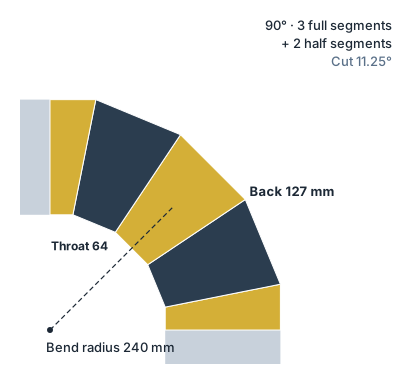
A bend with n full segments has n + 1 joints. The two end pieces are half segments: they have one slanted side only, the other side is square and joins the straight pipe.
| Bend angle | Full segments | Segment angle | Cut angle |
|---|---|---|---|
| 90° | 1 | 45° | 22.5° |
| 90° | 2 | 30° | 15° |
| 90° | 3 | 22.5° | 11.25° |
| 60° | 2 | 20° | 10° |
| 45° | 1 | 22.5° | 11.25° |
Back and throat
Every segment is longer on the outside (the back) than on the inside (the throat). With the bend radius Rb measured to the pipe centerline and the pipe radius r:
- Back length of a full segment = 2 × (Rb + r) × tan(cut angle)
- Throat length of a full segment = 2 × (Rb − r) × tan(cut angle)
- Half segments have half of these values, plus the straight stub.
An example: pipe OD 160 mm, bend radius 240 mm, 90° with three full segments. The cut angle is 11.25°, tan = 0.199. Back = 2 × 320 × 0.199 = 127 mm (5.01 in), throat = 2 × 160 × 0.199 = 64 mm (2.51 in).
Cutting
From pipe: mark back and throat length alternately and turn the pipe by 180° after every cut. All segments then come out of one length. A continuous line scribed along the pipe is essential so that back and throat lie exactly opposite each other.
From sheet: the flat pattern of a segment is a strip with two opposing sine curves. Add allowances for seam or overlap, and remember that the sheet thickness changes the effective diameter.
Assembly
- Lay out the segments in the right order and line up the scribed lines.
- Tack every joint at four points and check the angle with a gauge or against a layout on the bench.
- Weld out only when the whole bend is tacked – alternating between joints so distortion does not add up.
Common mistakes
- End pieces cut as full segments: the bend comes out one segment angle too large.
- Bend radius measured at the back instead of the pipe centerline.
- Sheet thickness ignored: the pipe becomes too tight or too loose.
The segmented bend calculator returns segment angle, lengths and the 1:1 templates. For a single kink a miter cut is enough.