Why half the angle
Two pipes that meet at a corner must show the same cross-section at the joint – otherwise one of them stands proud. That is only the case when the joint bisects the angle between the pipes exactly. Cutting one pipe at 30° and the other at 60° also adds up to 90°, but the two ellipses have different lengths.
| Change of direction | Cut angle per pipe | Length difference at 42.4 mm (1.669 in) OD |
|---|---|---|
| 30° | 15° | 11.4 mm (0.447 in) |
| 45° | 22.5° | 17.6 mm (0.691 in) |
| 60° | 30° | 24.5 mm (0.964 in) |
| 90° | 45° | 42.4 mm (1.669 in) |
The length difference is the amount by which the outside of the corner is longer than the inside: diameter × tan(cut angle).
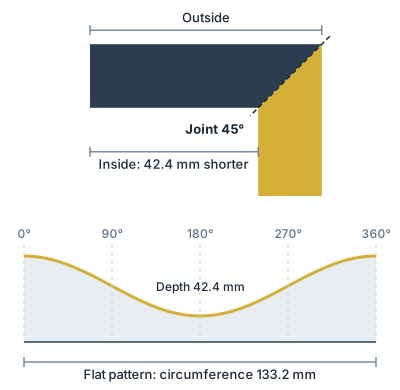
The template
A saw with an angle stop needs no template. It helps where sawing is not possible: on installed pipe, on large diameters or when cutting with an angle grinder. The unrolled cut line is a simple sine wave over the circumference:
h(θ) = r · tan(cut angle) · (1 + cos θ)
The same template fits both pipes; for the second one it is applied turned by 180°.
Getting the corner right
- Scribe a line along both pipes that will later be on top.
- Always measure the length on the same side – usually the outside of the corner.
- Align the template to the scribed line, mark and cut.
- Grind the cut faces flat and tack the pipes in a square or a fixture.
- Check the angle before welding out: the weld pulls the corner closed as it cools.
Handrails: the kink between stair and landing
Where a handrail changes from the pitch of the stair to horizontal, the change of direction equals the pitch of the stair. At 34° pitch each pipe is cut at 17°. If the stair also turns in plan, the result is a compound angle – then a bend or two separate kinks are the better choice.
Distortion and weld
Thin-walled pipe distorts easily at a miter. Tack at four points crosswise and weld in short sections on opposite sides. On stainless handrails the weld is then ground flush and re-finished in the grain of the pipe, so the corner looks like one piece.
The pipe miter template delivers the 1:1 pattern for any angle. If a pipe meets the side of another pipe, it is not a miter but a saddle cut; wide bends are built as a segmented bend.